The articles in this blog by Central City Opera are licensed under a Creative Commons Attribution-ShareAlike 3.0 Unported License.
Showing posts with label THE SOUND OF MUSIC. Show all posts

Wednesday, August 6, 2014

Designer Dave Bova Reveals What’s Beneath the Wigs


Three summers with Central City Opera, eighteen Broadway credits, and thirty-two wigs in The Sound of Music. When asked how many hairs it takes to ventilate a single wig, consummate Wig and Makeup Designer Dave Bova wisecracked, “Oh God I don’t know. As many hairs as on the human head…thousands or more.”

Bova has established himself as one of the business’ most sought-after designers – the business of course including straight theatre, musicals, and opera in professional and educational environments alike. Bova often finds himself juggling eight to ten projects simultaneously with each show opening within a three-month period, and somehow he manages it without coughing up any hairballs. “I have an assistant who’s better than me,” Bova humbly explained.

Dave Bova's headshot, courtesy of his webpage.
In his nearly twenty-year career, Bova has seen wig designs evolve just as theatrical aesthetics too have shifted. “The scale of the hair style would be different. Opera houses are bigger so the hair would be too. That’s not true anymore; in the last two decades opera has taken a more realistic turn mostly because people want to see a movie on stage,” he said. “Wigs aren’t supposed to look wiggy now.”

Nowadays, designers like Bova neither attempt to make unbelievable wigs nor do they necessarily strive for historical accuracy. “If you want to see period-correct, go to a museum,” Bova bluntly stated. “When you’re designing, whether it’s set, costume, or hair, it’s not about period-correct. It’s about what the audience will perceive is real for that show.” Styles that were in vogue decades or centuries ago may look anachronistic on stage even if presented truthfully. Thus a crafty wig designer must sculpt not only what unifies the show’s composition but also what looks reminiscent of how changing audiences will understand the given period.

Bova put this in perspective for The Sound of Music, his final show for Central City Opera’s 2014 Festival. “Maria’s wig for her wedding is pushing forward in time. The original Maria had her hair pulled back in a bun, but that’s not very glamorous for the stage,” he shared. He also added that in his research images, “every one of the von Trapp kids were brunettes,” but for Americans to realistically perceive the characters as full-blood Austrians it helps to style them as mostly blondish.

Troy Cook as Captain von Trapp and Kate Maley as Maria, sporting
one of Bova's wigs, in The Sound of Music. Photo by Mark Kiryluk.
And just in case there was any doubt about why historicism may not be so practical in today’s theatre, Bova recalled our ancestors' less than ideal hygienic habits. “Georgian women would wash their hair every three months. We hardly use the real versions because people today wouldn’t find it as pretty,” he said.

It’s not just the type of theatre or the show’s setting that influences a wig’s style – it’s also the genre. “The biggest difference is if it’s a comedy or a drama or a tragedy; that will really determine look,” Bova described. The former genre may be more prone to exaggerated and larger-than-life wigs while the latter two might more often be rooted in realism.

Bova also shared his experiences working in juxtaposed theatrical settings. “In commercial theatre, if you screw up the show closes. In educational theatre the goal is to have a good experience – it’s not about the end product, it’s about the student learning,” he shared. “I like them all. When I get sick of one I do the other so it refreshes me. It’s a good balance.” Central City Opera uniquely blends these contrasting settings: the shows are produced by opera’s finest, but Bova also gets to oversee and teach a handful of assistants and interns each summer.

With the help of a patron, Bova demonstrates putting on a beard backstage at the
 Opera House during this year's Opera Inside-Out. Photo by Erin Joy Swank.
Regardless of the venue, Bova did agree on one key ingredient for any design process’ success. “Everyone has to make a strong choice, even if you don’t agree with it,” Bova said. “And then everyone must compromise so that we can all have a collaborative effort. That’s theatre.” With such a specific niche as makeup and wig design, Bova often has to defend his choices by the only way a designer most effectively can – through show and tell. If a director wants to put a honey-blonde wig on an actor with jet-black hair, “I prepare for what they want even if I disagree. I make two wigs – what they want and what I think works best – and put both of them up there, and 90% of the time I win. You must trust your instincts.” Bova also makes sure that the wig aligns with the costume and especially lighting designs as a colored gel can easily manipulate what a wig looks like under working stage lights. All of this, of course, reinforces Bova’s mantra that theatre is a collaborative art.

“If you don’t like that process then go paint a painting,” said the lovably salty Bova.

It mustn’t be forgotten that Bova also doubles as a makeup designer. While this process similarly entails research images and communication with the director and other designers, its execution is undeniably less time-consuming than creating a wig or even a mustache from scratch. Bova elegantly summed up his technique in a likewise brief way: “Makeup isn’t about changing your skin tone; it’s about flavoring it.”

Last year Bova designed The Barber of Seville for
Central City Opera's 2013 Festival. Photo by Mark Kiryluk.
With so many tasks to complete, employees to manage, and designs to create, it’s clear why time plays such an important factor in Bova’s work. A faultless day for Bova, then, involves “having everything just fit, like a puzzle. Having copious amounts of time and schedule not being an object is lovely,” he said. Another version of an ideal day is a bit more lax. “Going to karaoke, cooking a meal…I never get to cook because I’m always busy. In both respects what ties A and B together is having no restriction of time,” he stated.

Bova then captured the plight and wonder of an artists’ process. “It’s like eating – you can eat a beautiful meal fast, but it comes at a price,” he said. “There’s always money and the quality is high, but there’s never enough time. You can get it all done, but you never get to stop and smell the roses.”

Too many restrictions on time can only lead to onstage mishaps, creating a wig designer’s worst nightmare. “I did Cirque du Soleil and a guy had a wig fall off. He was also flipping thirty feet in the air and I only had two minutes to put it on him. You know, give me impossible tasks and the impossible will happen,” Bova said.

The wig worn by the businesswoman Elsa (Lucy Schaufer, The Sound of Music)
shows a more progressive look than what may have been commonplace in 1940's Austria. Photo by Mark Kiryluk.
Bova also has to manage another near impossible task, even if it’s unrelated to wigs or makeup. “You have to make times for your personal life,” he said. “You have to schedule visits, even in the middle of show.” While he’s stationed in New York, Bova is sometimes more often than not away from his home. “The hardest part is never sleeping in your own bed,” said an upbeat Bova, chuckling at his vagrant lifestyle.

What, then, propels Bova to leave his home, fill a taxi with wigs as if it were a clown car, and temporarily settle in obscurer parts of the globe?

“I come back for the lack of oxygen,” Bova joked of his stint in the Rockies. “No, we’re a family here. I kind of have a home in New York, but I come here for a summer and I sleep in the same bedroom and I have the same friends.”

Bova, once more the wordsmith, encapsulated his cosmopolitan career. “I have been paid to see so much of the world,” he smiled.

He may traverse the country and rub elbows with the likes of Betty Buckley or James Lapine, but at Central City Opera Bova has the rare treat in the arts to return to old friends and designers each summer. “People trust me here,” he said of Central City’s intimate family. “For a collaborative art to have a similar team again...it’s very enjoyable.”

Catch Dave Bova's wig and makeup designs in The Sound of Music, playing through this Sunday, August 10 at the Ellie Caulkins Opera House in the Denver Performing Arts Complex.

Thursday, July 31, 2014

How well do you know the von Trapps?

The story of the von Trapp family has changed quite a bit over the years. There were even differences between the autobiographies written by Maria von Trapp and her stepdaughter Agathe (portrayed as Liesl in The Sound of Music). Can you guess where the following situations first appeared?

Your choices are:
A. Real life
B. The 1956 German film Die Trapp-Familie, which you can watch on YouTube (including English subtitles if you choose closed captions) 
C. The 1959 Broadway musical The Sound of Music 
D. The 1965 film The Sound of Music 

  1. Georg von Trapp uses a whistle to summon his children.
  2. Maria creates clothing for the children out of old curtains.
  3. Maria sings “I Have Confidence” while leaving the Abbey for the von Trapp villa.
  4. Maria and Georg return from their honeymoon a few days after the Anschluss (Nazi occupation.)
  5. It is the von Trapp boys’ idea to enter the music festival competition.
  6. Max Detweiler acts as the family’s manager.
  7. The von Trapps hide in the Abbey before escaping to Switzerland.
  8. Brigitta von Trapp is ten years old.
  9. Maria discusses warm wool mittens.
  10. Louisa can reportedly climb the trellis with a toad in her hand.
The answers can be found on page 49 of Central City Opera's 2014 Opera Insider Festival Resource Guide.

The Sound of Music plays exclusively in the Ellie Caulkins Opera House of the Denver Performing Arts Complex from August 2-10, 2014.

Wednesday, July 30, 2014

The Sound of Music: Comparing Timelines

The stage and screen versions of The Sound of Music were based on the real-life story of Maria von Trapp....but the timeline of events was severely condensed for dramatic purposes. Take a look below at the comparison; the musical compresses almost twelve years into a little more than three months on stage.
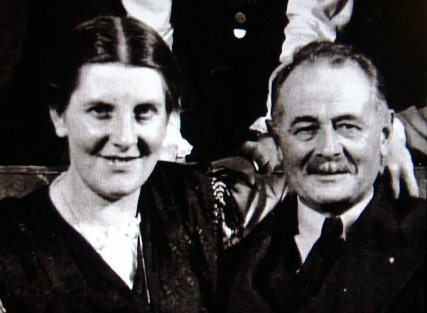
Maria and Georg von Trapp, whose story famously became The Sound of Music (image from FindAGrave.com)
Troy Cook and Katherine Manley in Central City Opera's production, running in Denver August 2-10, 2014 (photo by Kira Horvath)
REALITY MUSICAL
Georg von Trapp is born in 1880, Maria Augusta Kutschera born 1905

Around 1924 or 25 - Maria enters convent, after graduating college [age 19? - she was there for 2 years]

Around October 1926 - Maria is sent to von Trapps until June - he is 46, she 21, just four years older than eldest son

March 1927 – Princess Yvonne arrives (a distant relative of Georg’s first wife), Yvonne tells Maria that Georg’s in love with Maria but will still marry Yvonne

May 1927 – von Trapp is determined to be engaged to Princess Yvonne but gets pert note from Maria, calls off proposal to Yvonne; thirteen days before Maria is to leave he uses children to ultimately propose (a bit of a modern game of “Telephone”)

November 26, 1927Wedding

1933 - von Trapps lose money investing in Austrian banks, began to take in boarders

Easter 1935 - Father Wasner comes to villa, becomes choral manager

August 1936 – Soprano Lotte Lehman hears singing, insists they do concerts, enter the Salzburg Festival for group singing, which they win; then invited to radio broadcast, heard by Austrian Chancellor Kurt von Schuschnigg who invites them to sing in Vienna; soon the von Trapps are touring the whole map of Europe

1937 - First European tour

March 12, 1938 - Anschluss, the Nazi occupation of Austria

May 1938 – Nazis notice they’re not hanging flags

June 1938 – Decline Germans three times in one week, Escape in broad daylight on train to Italy
Dec. 12, 1937*; “until September” - Maria Rainer is sent to von Trapps

Six Weeks Later [Jan. 23, 1938] - Elsa arrives

One Week Later [Jan. 30, 1938] - Party; Brigitta tells Maria that Captain is in love with her, Maria runs away

Three days later [Feb. 2, 1938]- Maria returns, she and Georg are engaged

Two weeks later [Feb. 16, 1938] – Wedding

One month later [March 16, 1938] - von Trapps return from honeymoon and receive news of the new commission (we are told Anschluss was four days ago—the Nazi occupation of Austria on March 12, 1938)

Three days later [March 19, 1938] - Kaltzberg Festival and Escape [Depicted in the film as being the same night they return from their honeymoon]

* NOTE: Musical “dates” above are based off the historical date of the Anschluss in Act Two, adjusting other dates by the days and weeks mentioned between scenes.

This timeline was created for Central City Opera's 2014 Opera Insider by Erin Joy Swank, Production Manager/Stage Manager for Education & Community Engagement. Learn more about the creation of The Sound of Music (and the rest of the 2014 Festival) and read interviews with several of the cast members by checking out additional articles.

Monday, July 28, 2014

MONDAY NUN DAY: Richard Rodgers' Research for The Sound of Music

For today's Monday Nun Day posting, we take a look into the creation of the music sung by the nuns in The Sound of Music. Did you know that this liturgical-style music was written specifically for the production? There's also quite a bit more of it in the stage version than what you might remember from the iconic Julie Andrews film...and we're excited to share it with you during the Central City Opera 2014 Festival!
Richard and Dorothy Rodgers at Manhattanville College of the Sacred Heart at a concert arranged by Mother Morgan for research on The Sound of Music - Photo from New York Public Library Digital Gallery
Richard Rodgers wrote in Musical Stages: An Autobiography:
One musical problem confronting me was the opening piece. Rather than begin with the customary overture, we decided to open immediately on a scene in Nonnberg Abbey, in which the nuns are heard chanting a Catholic prayer, "Dixit Dominus." Since I had been so strongly against a score that combined old music with new, I could hardly fall back on using a traditional melody for the mass. Writing "Western" songs for Oklahoma! or "Oriental" songs for The King and I had never fazed me, but the idea of composing a Catholic prayer made me apprehensive. Given my lack of familiarity with liturgical music, as well as the fact that I was of a different faith, I had to make sure that what I wrote would sound as authentic as possible.
Richard Rodgers at Manhattanville College of the Sacred Heart - also from NYPL Digital Gallery
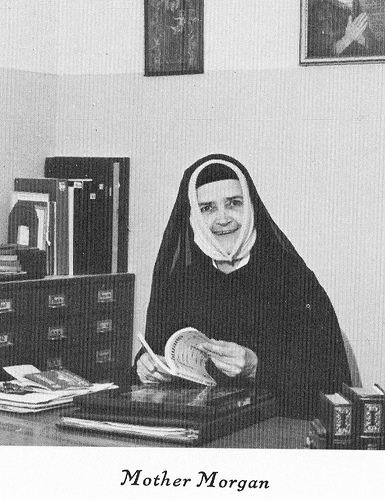
So for the first time in my life I did a little research - and it turned out to be one of the most rewarding music lessons I've ever had. Through friends I got in touch with Mother Morgan, the head of the music department at Manhattanville College in Purchase, New York. She was not only willing to help; she even invited Dorothy and me to a specially arranged concert at which the nuns and seminarians sand and performed many different kinds of religious music, from Gregorian chants to a modern work by Gabriel Fauré. An unexpectedly amusing moment came when Mother Morgan, waving her arms like a cheerleader at a football game, was vigorously conducting a particularly dramatic passage. As the music built to its peak, above the singing could be clearly heard Mother Morgan's booming command: "Pray it!"
Mother Morgan (above) assisted Ricard Rodgers in his research for creating the liturgical music for The Sound of Music.
Catch Richard Rodgers' beautiful music inspired by Mother Morgan and her fellow nuns during The Sound of Music. The production runs exclusively at the Ellie Caulkins Opera House in the Denver Performing Arts Complex, August 2-10, 2014.

Thursday, July 24, 2014

Maria Zifchak Discusses her Contrasting Maternal Roles


It's a good thing Maria Zifchak is a Libra. By day she pleads for her condemned son's life while suffocating under the publicity’s scrutiny, but by night she runs a private, bucolic convent while offering sage advice. Of course Ms. Zifchak is only acting in both scenarios, but her performances are so convincing one would think she was leading a double life. 

“These roles are vastly different,” Zifchak said in reference to playing the tenacious Mrs. De Rocher in Dead Man Walking and the iconic Mother Abbess in The Sound of Music.

Maria Zifchak's headshot as featured on her website.
Central City Opera's Dead Man Walking opened on July 5, but Zifchak still finds herself navigating the show’s moral gray area as the mother of a death row inmate who raped and murdered a teenage girl. “There are still some things that are hard to understand,” said the seasoned mezzo-soprano. “How does a person feel having a family member, someone that they created, do such a terrible thing? I’m not a mother. I’ve said that through this whole rehearsal process; I don’t know how I’d handle it.”

Though not a mother, Zifchak possesses the genuine warmth and compassion all parents strive to exude, and she gracefully brings these traits to her Mrs. De Rocher. “It is a stretch. I have to try to think in a motherly way, but you can almost do that by thinking about your family,” she stated. “Even with nieces and nephews you worry about them and think what their future will be, so that’s kind of motherly.”

Zifchak has performed with the esteemed Metropolitan Opera, but she is facing one of her most challenging roles here during her fourth season in Central City. “She seems like the kind of person who didn’t have that great of a life, but she did the best she could with raising her kids. No matter how you raise your kids, you are a product of your environment,” Zifchak said of Mrs. De Rocher. “I still try to discover the ah-ha moments to get her inside me.”

Zifchak, as Mrs. De Rocher in Dead Man Walking, says goodbye to
her son Joseph, played by Michael Mayes. Photo by Mark Kiryluk.
And after completing a harrowing matinee, Zifchak gets to moonlight in a cheerier role where she’s often spotted high-fiving the Von Trapp children and cracking jokes with cast members. The Sound of Music, opening on August 2 in Denver, may be a lighter piece, but Zifchak is facing yet another challenge: this will be her first musical since high school. “The show’s a completely different tone. It’s laidback, its fun, but at the same time there’s a lot of stress because everybody knows this show,” she proclaimed robustly.

On top of the musical’s fame, Zifchak also has to tackle “Climb Ev’ry Mountain,” one of musical theatre’s most well-known anthems. “It’s a little nerve-racking, but the song brings out your inner strength,” she said.

When comparing her two motherly roles, Zifchak said, “Mother Abbess is completely different structure-wise. She lives in a stricter world; there were rules, there were things you had to do in order to run this abbey. It was just a more structured life, easier in a way than Mrs. De Rocher’s.”

With roles this rich, Zifchak doesn’t seem to mind that she’s playing two mother figures in one season. “I guess typecasting bothers some people, but if it makes the show more believable then you’ll be cast how others see you!” quipped Zifchak.

The dual roles have certainly kept Zifchak occupied, but she still makes time to hike with her three dogs and even people-watch at the local casinos. Her time here may be approaching its end, but Zifchak is savoring each moment. “This summer has been a challenge; it has been the gamut of emotions,” she said deliberately. “I’m glad to have these roles because they’re not that big – they make their impact, and then they go.”

In perhaps Dead Man Walking’s most poignant moment, Zifchak as Mrs. De Rocher asks Sister Helen to take a picture of her and her sons knowing that their family of four will soon be reduced to three. Zifchak takes the center seat, adjusts her hair, and proudly gathers her boys around her. The camera flashes, capturing the smiling family for just a moment before it disappears, fading from everywhere but our memories.


Catch Maria Zifchak in the final performance 
of Dead Man Walking on Friday, July 25, 
and then come down to Denver for
The Sound of Music from August 2-10!

Saturday, June 21, 2014

Central City Celebrates Annual Madam Lou Bunch Day


Central City is lovably quirky.

It’s known simultaneously for its singing Opera House and dinging casinos. Its elevation is nearly 8,500 feet, placing it among the highest cities in the country. And once a year it’s host to dames on beds being pushed around by townsfolk in drag.

Interns McEntee, Abernathy and Ting posing in costume
in the Opera Garden before the Madam Lou Bunch parade commenced
Madam Lou Bunch Day is arguably Central City’s most unique event. Bunch was a notorious prostitute in the 1880s who allegedly grew too wide to physically leave her brothel’s brass bed. To annually commemorate one of Central City’s most colorful characters, locals dress up in costumes ranging from stuffy Victorian to saucy barmaid. Additionally, many compete in the Bed Races where a pair of boys push ladies-on-beds-on-wheels up and down Main Street. The teams often dress in a costumed theme, with prizes for the fastest teams and slickest costumes.

Ladies of Central City dress up as brothel women
for Madam Lou Bunch Day and pose on the bed that was used in the races
Eight teams competed in the Bed Races this year, all representing local businesses from Century Casino to Central City Opera. This year three CCO interns (cross-)dressed as characters from the upcoming three shows in the 2014 Festival. Props Intern Austin Abernathy owned the garconne look with his flappers dress for The Marriage of Figaro, which will be set in the 1920s. Assistant House Manager Dahlia Ting donned prison garb (and a myriad of tattoos) to showcase Dead Man Walking, and Marketing/Public Relations Assistant Billy McEntee dressed as a nun for The Sound of Music.

Abernathy pushes McEntee and Ting uphill during the back nine of the Bed Races
While these dynamic garments sadly did not merit the Best Costumes award, the three youngsters did take home the Maiden Voyage ribbon for their first time competing. The speedy workers at Johnny Z's Casino, the reigning champions, came in first place and won $300. Nevertheless, the CCO racers succeeded in advertising their upcoming productions and entertaining townsfolk with their enthusiasm, irreverent costumes and loopy steering.

Thursday, October 31, 2013

The Sound of Music....Horror Film?

Happy Halloween!

The 1965 Julie Andrews film The Sound of Music has become such an icon of American culture, it can't help but be parodied. Quite often. One popular theme is to reset this sweet movie as a horror film. We've been featuring several of these "trailers" on our Facebook page throughout the week, and here's a culmination of the best ones we've found. Which is your favorite?

"The Sound of Music (Horror Trailer)" by MNMantylaVideo
This trailer is part The Sound of Music, part The Turn of the Screw. "You are the twelfth in a long line of governesses....the last one, she stayed only two hours."


"The Sound of Music Recut Trailer - Horror" by chuck13171
I rather like the pacing of the soundtrack and the editing in this particular trailer. "Mother, would it help if we sang about our favorite things?" "No, darling, this is one time it would NOT help." 

This one focuses on Captain von Trapp. Should it be The Sound of Murder instead?

Just when they thought it was safe...


"Sound Of Music Recut Trailer (HORROR)" by Hannah OneTwoNine
Everyone loves Maria...almost everyone...


"The Sound Of Music RECUT" by BoundlessProductions
And finally, remember how Maria mentions "perhaps I had a wicked childhood"?...


Remember, you can see the not-so-horror-filled stage version of The Sound of Music in August 2014, when Central City Opera performs the show at the Ellie Caulkins Opera House in the Denver Performing Arts Complex.

Monday, August 26, 2013

Monday Nun Day: Happy Birthday, Mother Teresa!

Looking ahead to next year’s productions of Dead Man Walking and The Sound of Music, we are launching an occasional “Monday Nun Day” series. Today’s date just happens to coincide with the birthday of one of the world’s most famous nuns, Mother Teresa, born August 26, 1910. In 1999, a poll of Americans ranked her first in Gallup's List of Most Widely Admired People of the 20th Century.