The articles in this blog by Central City Opera are licensed under a Creative Commons Attribution-ShareAlike 3.0 Unported License.
Showing posts with label Opera History. Show all posts

Wednesday, July 22, 2015

Where in the World is La Mancha?

“La Mancha,” translates as “The  Channel” and refers to a wide bleak plain in Spain (pictured above in red). It can also be translated as “The Stain” - not great for a knight’s home base. The climate, according to Dale Wasserman (Man of La Mancha), is “Nine months of winter and three months of hell...It’s easy to invent fantasies in La Mancha, to believe that men might go mad and invent worlds not yet made.”


The red route traced below was published in the 1780 illustrated Spanish edition of Don Quixote, following the title character’s adventures, including:
· Argamasilla de Alba—Don Quixote/Alonso Quijana’s village (scholars think)
· El Toboso—home of Dulcinea
· Puerto Lápice—location of the Inn where Don Quixote was “knighted”
· Cave of Montesinos—site of one of Don Quixote’s adventures
Compiled by Erin Joy Swank (Education & Community Engagement) for our 2015 Opera Insider (Festival Resource Guide). Download your free copy today!
Central City Opera's Man of La Mancha runs through August 9, 2015; Don Quixote and the Duchess performs July 28 and August 1 in Central City, August 6 in Ft. Collins.

Thursday, July 31, 2014

How well do you know the von Trapps?

The story of the von Trapp family has changed quite a bit over the years. There were even differences between the autobiographies written by Maria von Trapp and her stepdaughter Agathe (portrayed as Liesl in The Sound of Music). Can you guess where the following situations first appeared?

Your choices are:
A. Real life
B. The 1956 German film Die Trapp-Familie, which you can watch on YouTube (including English subtitles if you choose closed captions) 
C. The 1959 Broadway musical The Sound of Music 
D. The 1965 film The Sound of Music 

  1. Georg von Trapp uses a whistle to summon his children.
  2. Maria creates clothing for the children out of old curtains.
  3. Maria sings “I Have Confidence” while leaving the Abbey for the von Trapp villa.
  4. Maria and Georg return from their honeymoon a few days after the Anschluss (Nazi occupation.)
  5. It is the von Trapp boys’ idea to enter the music festival competition.
  6. Max Detweiler acts as the family’s manager.
  7. The von Trapps hide in the Abbey before escaping to Switzerland.
  8. Brigitta von Trapp is ten years old.
  9. Maria discusses warm wool mittens.
  10. Louisa can reportedly climb the trellis with a toad in her hand.
The answers can be found on page 49 of Central City Opera's 2014 Opera Insider Festival Resource Guide.

The Sound of Music plays exclusively in the Ellie Caulkins Opera House of the Denver Performing Arts Complex from August 2-10, 2014.

Wednesday, July 30, 2014

The Sound of Music: Comparing Timelines

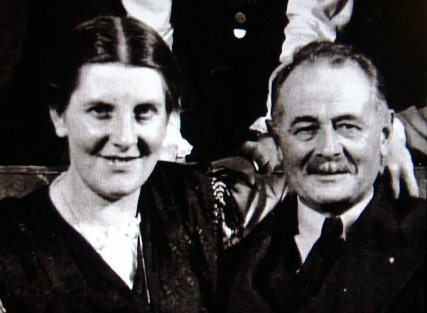
The stage and screen versions of The Sound of Music were based on the real-life story of Maria von Trapp....but the timeline of events was severely condensed for dramatic purposes. Take a look below at the comparison; the musical compresses almost twelve years into a little more than three months on stage.
Maria and Georg von Trapp, whose story famously became The Sound of Music (image from FindAGrave.com)
Troy Cook and Katherine Manley in Central City Opera's production, running in Denver August 2-10, 2014 (photo by Kira Horvath)
REALITY MUSICAL
Georg von Trapp is born in 1880, Maria Augusta Kutschera born 1905

Around 1924 or 25 - Maria enters convent, after graduating college [age 19? - she was there for 2 years]

Around October 1926 - Maria is sent to von Trapps until June - he is 46, she 21, just four years older than eldest son

March 1927 – Princess Yvonne arrives (a distant relative of Georg’s first wife), Yvonne tells Maria that Georg’s in love with Maria but will still marry Yvonne

May 1927 – von Trapp is determined to be engaged to Princess Yvonne but gets pert note from Maria, calls off proposal to Yvonne; thirteen days before Maria is to leave he uses children to ultimately propose (a bit of a modern game of “Telephone”)

November 26, 1927Wedding

1933 - von Trapps lose money investing in Austrian banks, began to take in boarders

Easter 1935 - Father Wasner comes to villa, becomes choral manager

August 1936 – Soprano Lotte Lehman hears singing, insists they do concerts, enter the Salzburg Festival for group singing, which they win; then invited to radio broadcast, heard by Austrian Chancellor Kurt von Schuschnigg who invites them to sing in Vienna; soon the von Trapps are touring the whole map of Europe

1937 - First European tour

March 12, 1938 - Anschluss, the Nazi occupation of Austria

May 1938 – Nazis notice they’re not hanging flags

June 1938 – Decline Germans three times in one week, Escape in broad daylight on train to Italy
Dec. 12, 1937*; “until September” - Maria Rainer is sent to von Trapps

Six Weeks Later [Jan. 23, 1938] - Elsa arrives

One Week Later [Jan. 30, 1938] - Party; Brigitta tells Maria that Captain is in love with her, Maria runs away

Three days later [Feb. 2, 1938]- Maria returns, she and Georg are engaged

Two weeks later [Feb. 16, 1938] – Wedding

One month later [March 16, 1938] - von Trapps return from honeymoon and receive news of the new commission (we are told Anschluss was four days ago—the Nazi occupation of Austria on March 12, 1938)

Three days later [March 19, 1938] - Kaltzberg Festival and Escape [Depicted in the film as being the same night they return from their honeymoon]

* NOTE: Musical “dates” above are based off the historical date of the Anschluss in Act Two, adjusting other dates by the days and weeks mentioned between scenes.

This timeline was created for Central City Opera's 2014 Opera Insider by Erin Joy Swank, Production Manager/Stage Manager for Education & Community Engagement. Learn more about the creation of The Sound of Music (and the rest of the 2014 Festival) and read interviews with several of the cast members by checking out additional articles.

Monday, July 28, 2014

MONDAY NUN DAY: Richard Rodgers' Research for The Sound of Music

For today's Monday Nun Day posting, we take a look into the creation of the music sung by the nuns in The Sound of Music. Did you know that this liturgical-style music was written specifically for the production? There's also quite a bit more of it in the stage version than what you might remember from the iconic Julie Andrews film...and we're excited to share it with you during the Central City Opera 2014 Festival!
Richard and Dorothy Rodgers at Manhattanville College of the Sacred Heart at a concert arranged by Mother Morgan for research on The Sound of Music - Photo from New York Public Library Digital Gallery
Richard Rodgers wrote in Musical Stages: An Autobiography:
One musical problem confronting me was the opening piece. Rather than begin with the customary overture, we decided to open immediately on a scene in Nonnberg Abbey, in which the nuns are heard chanting a Catholic prayer, "Dixit Dominus." Since I had been so strongly against a score that combined old music with new, I could hardly fall back on using a traditional melody for the mass. Writing "Western" songs for Oklahoma! or "Oriental" songs for The King and I had never fazed me, but the idea of composing a Catholic prayer made me apprehensive. Given my lack of familiarity with liturgical music, as well as the fact that I was of a different faith, I had to make sure that what I wrote would sound as authentic as possible.
Richard Rodgers at Manhattanville College of the Sacred Heart - also from NYPL Digital Gallery
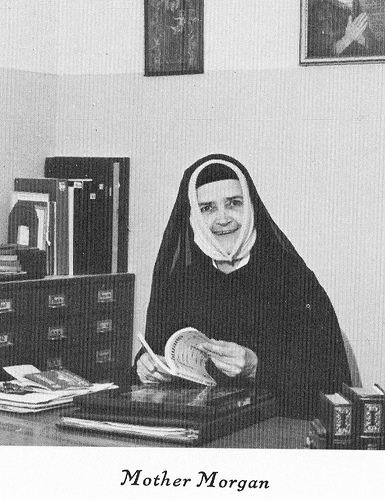
So for the first time in my life I did a little research - and it turned out to be one of the most rewarding music lessons I've ever had. Through friends I got in touch with Mother Morgan, the head of the music department at Manhattanville College in Purchase, New York. She was not only willing to help; she even invited Dorothy and me to a specially arranged concert at which the nuns and seminarians sand and performed many different kinds of religious music, from Gregorian chants to a modern work by Gabriel Fauré. An unexpectedly amusing moment came when Mother Morgan, waving her arms like a cheerleader at a football game, was vigorously conducting a particularly dramatic passage. As the music built to its peak, above the singing could be clearly heard Mother Morgan's booming command: "Pray it!"
Mother Morgan (above) assisted Ricard Rodgers in his research for creating the liturgical music for The Sound of Music.
Catch Richard Rodgers' beautiful music inspired by Mother Morgan and her fellow nuns during The Sound of Music. The production runs exclusively at the Ellie Caulkins Opera House in the Denver Performing Arts Complex, August 2-10, 2014.

Tuesday, July 1, 2014

What to Listen for in THE MARRIAGE OF FIGARO

Today's blog post is from an article in our 2014 Opera Insider Festival Resource Guide, written by Education & Community Engagement Coordinator Emily Murdock.

Music & Class Status

Mozart’s librettist for The Marriage of Figaro was Lorenzo Da Ponte. This was their first collaboration (of three), and it’s often said that Mozart and Da Ponte were the Dream Team of opera. Da Ponte adapted Beaumarchais’s 1784 play La folle journée, ou le Mariage de Figaro into a tight, clever libretto. But since Da Ponte was well aware that Beaumarchais had gotten into hot water over his politically charged play, he was careful to avoid any potentially inciting scenes and lines in his libretto. Instead, this controversial content played out in Mozart’s music. 

In the Classical era (as we now know it) of opera, it was conventional for the noble and upper class characters to sing a recitativo accompagnato, or accompanied recitative, before their major aria. Recitativo accompagnato is recitative that is accompanied by the full orchestra, not just the harpsichord and basso continuo (usually played by the cello). It gives the impression that the singer is commanding the response of the orchestra or vice versa – very much a dialogue between the two musical entities. It was not conventional for a character of a lower class to sing this particular form. But in The Marriage of Figaro, Mozart gave all four of his main characters – the Count, the Countess, Figaro, and Susanna – accompanied recitative and arias. This put the servants on equal footing as their masters – an idea that was blatantly obvious in the French play, but made more subtle in the opera. Consider also the order in which Mozart has the characters singing their arias:  the Count in Act 3, scene 4 (“Hai già vinta la causa”…”Vedrò mentre io sospiro”); the Countess in Act 3, scene 8 (“E Susanna non vien”….”Dove sono”); Figaro in Act 4, scene 8 (“Tutto è disposto”…”Aprite un pó quegl’occchi”); and Susanna finally in Act 4, scene 10 (“Giunse alfin il momento”…”Deh vieni non tardar”). Does this order mean that the servants get the last word? And in addition to that, do the women get the last word over the men? This is a possibility, and the idea very much underlines the themes in the play.

Another convention that Mozart broke is through his use of rustic meters in unexpected contexts. Rhythmic meter in music is the organization of music into regularly recurring measures or bars of stressed and unstressed "beats.” “Rustic” meters were those that had the feeling of triplets, like 6/8. They were to be used exclusively for lower class characters in certain situations, like peasant dances or shepherds singing, for example. Possibly to put his two heroines on more equal footing, Mozart uses the 6/8 meter in the famous duet between Susanna and the Countess, Sull’aria”…“Che soave zeffiretto,” when they are writing a letter together to deceive the Count. 

It may be one of the most beautiful and serene-sounding duets of all time, yet it is in the meter of a lower class. 

Mozart does this again in Susanna’s aria “Deh vieni non tardar” near the end of the opera. After singing her “noble” accompanied recitative, Susanna sings a beautiful aria about anticipating love – set in a rustic meter while she is dressed as the Countess. Conversely, Figaro’s aria “Se vuol ballare” in Act 1 is set to a noble dance meter, the courtly minuet in 3/4. 


Figaro sings the words “If he wants to dance, my dear little Count, I’ll play the guitar for him, indeed.” The fact that a servant sings these impertinent words to a noble dance meter clearly turns the tables on who is in control in this lower class/upper class relationship. These kinds of musical nuances may be lost on today’s audiences, but they were certainly pushing boundaries in Mozart’s time.


Check out the 2014 Opera Insider for the rest of Emily's article, as well as history on the productions and what inspired the composers and librettists to write them, interviews with the artists, conversation-starting questions and activities….even a musical version of Sudoku!

Thursday, August 23, 2012

The Welsh Musical Tradition - Past & Present

 This blog post was written by Irene Rawlings of KBCO FM.

On a recent trip to Wales, I visited the poet Dylan Thomas' hometown of Swansea and stayed in his childhood home at 5 Cwmdonkin Drive (now an authentically restored B&B that also serves great dinners). I expressed an interest in the Welsh choral tradition and was invited to a rehearsal of the Swansea Male Choir, founded in 1946 to “further the art of music and support local charities.”
A member of the Swansea Male Choir
I was moved by the joy that the Swansea male-voice choir members took in their singing but I was not surprised. There is a rich musical tradition in Wales—especially the male-voice choirs—whose songs provide the vibrant soundtrack to everything from chapel to the rugby field to the boisterous late-night sing-alongs in the local pubs. 

Who are these men? They are miners, steelworkers, quarrymen, farmers and shopkeepers. Many of the current members were brought to the choir by their male relatives back in a simpler time when choirs were a big part of village life. Yes, there were a lot of gray heads and even a wheelchair or two, but there were also plenty of young men in leather jackets and slicked back undercuts (think Boardwalk Empire) which makes me think that the Welsh male-voice tradition has a strong future.

As I sat at the Swansea rehearsal and heard everything from hymns to show tunes, I thought of the Central City Opera House back home in Colorado, built by Welsh and Cornish miners in 1878. How they must have missed the camaraderie of the choral tradition in their home country. And what a lovely opera house they built for us to enjoy still today.
Central City Hard-Rock Miners in 1889
I took out my cell phone and recorded one of the songs to share with you. It is not the quality that I would have liked but I'm thinking it will give you a good idea. And they were sitting down. Think of the power they unleash when they stand up and raise their voices in a concert hall. 


[Editor's Note: You may want to jump ahead to 30 seconds in or so.]

--Irene Rawlings from Swansea, Wales

Friday, August 3, 2012

"Malo" in THE TURN OF THE SCREW


Composer Benjamin Britten
This year’s opera The Turn of the Screw doesn’t have the ever-popular songs that Oklahoma! does, or even the familiar musical moments of La Bohème, but composer Benjamin Britten did include very tuneful children’s songs in the opera.  One notable song that could have several meanings is Miles’ song “Malo.” This verse was originally a pneumonic device to help beginning Latin students remember the different meanings and conjugations of the word “malo:” 1) verb “malo” meaning “I wish;” 2) the noun “malus” meaning “apple tree” and “malum” meaning “apple;” and 3) the noun “malum” meaning “evil” – but his song seems to have dark undertones, especially because Britten set it to very melancholy music. 

Here is the text of the song:

    Malo: I would rather be
    Malo: in an apple tree
    Malo: than a naughty boy
    Malo: in adversity       

Click here to hear Thomas Parfitt as Miles sing this song at the 2011 Glyndebourne Festival.  Remember this song, because you’ll hear a variation of it at the end of the opera. 

Britten’s The Turn of the Screw may not be mainstream, but it certainly leaves an impression.  We hope that you will get even more out of your experience having learned a little more about the music.  Enjoy the show!     

The Turn of the Screw plays its final performance on Saturday, August 4 at 8pm. Hurry to see it before it disappears!

Want to know more? This blog post is part of the article What to Listen for in The Turn of the Screw, found in the 2012 Opera Insider (Festival Resource Guide - PDF). We also excerpted the section on The Turn of the Screw’s twelve-tone row in a previous blogpost.

Saturday, July 14, 2012

Britten's Brilliant Twelve-Tone Row in THE TURN OF THE SCREW

Central City Opera opens its third mainstage production tonight with the creepy and cool opera The Turn of the Screw. While not as toe-tapping as the songs from this year's Oklahoma!, the score is very interesting. The opera is organized in a way that would thrill those of the Type-A personality. Benjamin Britten built the entire opera on a twelve-tone row, which is a non-repetitive ordering of a set of pitches. You can listen to the twelve-tone row here.
Twelve-Tone Row on which the opera is based

The opera is divided into two acts, with each act containing eight scenes, and the first act preceded by a Prologue. Before each scene, the chamber orchestra plays a short introduction based on the twelve-tone row you just heard. Each introduction features the instruments that are important in the following scene. You may be thinking: “Wow, this sounds so mathematical and boring. How can this music be interesting, dynamic, and evocative?” Britten was a genius at getting the music to serve the story. His use of instrumentation and speech-like melody brings out all of the colors and emotions of the drama happening on stage.

Listen again to that twelve-tone row, then watch the first scene of the opera below, produced by the Glyndebourne Festival in 2011. You’ll hear the main theme – with the twelve-tone row masterfully played by the entire orchestra – then the Governess’s first aria. Note the use of percussion in the theme and during the first scene. Britten uses the percussion to invoke the feeling of anticipation, excitement, and a bit of apprehension – all feelings that the Governess has as she is traveling to Bly House to begin her new job.

Want to know more? This blog post is part of the article What to Listen for in The Turn of the Screw, found in the 2012 Opera Insider (Festival Resource Guide - PDF).

Tuesday, July 3, 2012

June 30, 2012 Officially Declared Central City Opera Day!

Governor John Hickenlooper proclaims June 30, 2012 as "Central City Opera Day."
Central City Opera's Opening Day is always a special occasion. But the 2012 opening day was truly historic. The day was marked by a visit from Governor John Hickenlooper, who officially declared June 30, 2012 as "Central City Opera Day" in the State of Colorado.

Governor Hickenlooper shakes hands with Lanny Martin
The day's festivities began, as always, with the Flower Girl Presentation, a tradition dating back to 1932. This year, 14 young women were presented.

The 2012 Flower Girls stand with their escorts.
Following the presentation, Governor Hickenlooper made his official proclamation, just before the Flower Girls and their fathers took to Eureka Street for the Yellow Rose Waltz.

The day also included several other Central City Opera traditions, including the presentation of the Opera House keys to General/Artistic Director Pat Pearce, the ceremonial ringing of the bell by Board President/Chairman Nancy Parker, and the first performance of "The Usher Song" for the year. Those who have visited Central City Opera in years past may notice something very different about this year's ushers. More about that will be featured in a later blog.

Lanny Martin presents the Opera House Keys to Pat Pearce, CCO's General/Artistic Director.
Board President/Chairman Nancy Parker prepares to ring the bell.

Festival Staffers before singing "The Usher Song"

Sunday, June 24, 2012

Conversations With Ken Cazan: Part Two


Below are the final two installments of my interview with Ken Cazan, stage director of Oklahoma! Here he explains what makes Central City Opera's production unique and gives audiences a sneak peek at what to expect if they travel up the mountain for this production, including a preview of the scenic design by Alan E. Muraoka.


View Part One

For continued behind-the-scenes updates on Central City Opera's Oklahoma!, follow #CCityOK on Twitter!

Thursday, June 21, 2012

Conversations with Ken Cazan: Part One

This week, I was fortunate enough to steal Ken Cazan, the stage director for Oklahoma! away from rehearsals to chat about the production. Central City Opera fans might recognize Ken. Oklahoma! marks his eleventh production with Central City Opera. Last year, he directed the triple bill (Gianni Schicchi, Seven Deadly Sins, and The Breasts of Tiresias) and in 2010 he directed Three Decembers. But Oklahoma! isn't his first musical theatre piece. He is an accomplished director for both opera and theatre, having directed A Little Night Music and West Side Story for CCO previously.

Check out our conversation below to see what Ken has to say about the history and the cast of this summer's opening productions. If you have any more questions for Ken Cazan or the rest of the Oklahoma! production team, leave a comment below. Stay tuned for "Part Two" coming soon!


View Part Two

Monday, April 9, 2012

Central City Opera Celebrates Benjamin Britten

We're very excited to share the recently digitally-remastered clips from our 2002 production of Benjamin Britten's A Midsummer Night's Dream. Britten was born in 1913 and the "centenary" celebration of his works spans the 2012 and 2013 seasons of performing arts companies around the world.

Central City Opera has a rich tradition of producing the works of Benjamin Britten, which have a wide appeal for audiences. The composer himself is quoted as saying, "I write music for human beings." Central City Opera presented the North American premiere of Benjamin Britten's Gloriana in 2001, followed by this glorious production of Midsummer in 2002. Britten's work has since been performed on the Central City Opera stage in 2005 with the regional premiere of Paul Bunyan and in 2008 with productions of The Rape of Lucretia and Curlew River (the latter performed by our apprentice artists). This summer, we're proud to offer a new production of Britten's The Turn of the Screw, opening July 14th.

To whet your Britten appetite, here are four video clips from A Midsummer Night's Dream (2002):

Clip 1 - From Act One

Clip 2 - Tytania and Bottom

Clip 3 - The Rustics Perform


Clip 4 - Finale


In Paul Curran's Director's Notes for the 2002 production he wrote:
I have been lucky enough to work on the DREAM with two of Britten's own assistants: Steuart Bedford and Roderick Brydon. They have both made me look ever deeper into the music to see the piece more clearly. "If you can't see why I wrote (the music) that way, then don't conduct it" was Britten's advice to the young Steuart Bedford. "Play it again, I can't hear the colours. If there are no colours, there's no opera," another gentle encouragement. The colours of the opera and story are all in the orchestration; "every note counts, there is nowhere to hide in this score" - again, Britten to Bedford.
Steuart Bedford, mentioned above, conducted Central City Opera's 2005 regional premiere of Paul Bunyan and will return this summer to conduct The Turn of the Screw. Bedford was featured in the July 2011 issue of Opera News as "a peerless interpreter of the operas of Benjamin Britten." [The article is also available as a PDF.] Central City Opera presents The Turn of the Screw for the first time this summer with just six performances. Mark your calendar to join us on July 14, 18, 21, 29 or August 4 for this rare treat!

Wednesday, March 7, 2012

"Why I Like to Be the Last Person to Leave" - Memories of Central City Opera

We've invited everyone to share their fond memories of Central City Opera with our Show Us the Love Survey. One patron, Phil Dougan, was so excited to share with usthat he asked to submit a more lengthy description by e-mail, which we are very honored to now be able to share with you. Here it is in his own words:
After the University of Colorado’s graduation ceremony in May of 1970, I tumbled out into the world and, fortunately, into my first summer in Colorado. I’d never heard of an old mining town called Central City or of its opera house, and the news that Steinbeck’s Of Mice and Men had been configured into an opera had not reached me. My head was full of far more secular content – a fascination with foreign sports cars and  competing in parking lot slalom races with my roommate’s Datsun roadster. I borrowed it one Saturday morning for a little practice in the mountains, which eventually led me up Eureka Street toward the Central City Opera House. A psychic ambush if there ever was one, I drove about one car-length past the sign announcing that evening’s performance of Of Mice and Men, parked the car, found the ticket office open, and decided that I must go to that performance and on that very evening if I could.

Clearly my passions had turned a corner while I was steering straight ahead, a phenomena that was presaged by an event that had occurred six years earlier, when I was junior in high school, and suburbia was all that I knew. I was bored by a world of fruit-cocktail-laden Jell-o and terrible AM radio, but when West Side Story arrived in local theaters, I was not bored. Bernstein’s stunning music and the dance and the color illuminated an expanse of my soul that had never before seen the light of day, and I was swept away. But the memories of my intense delight and longing began to recede and fell into a long slumber. That was the best that I could do in Bettendorf, Iowa, circa 1964.

But on a summer afternoon six years later, a reservoir of longing in that neglected backwater of my psyche rose up and would have its way with me; I was going to the opera and in surroundings that only deepened the seduction. I sped back to Boulder (more practice, but with purpose) to draw my girlfriend into my quest. She agreed, so we made our best attempt to dress up, drove westward, and arrived in time to purchase tickets in the balcony.

I assume that it was opening night, because a surprising number of patrons had flowers tucked under their seats that they would launch at the end of the evening. I can report with more certainty what happened to me. Starting early in third act, I began to have what to this day I can only describe as a transcendent experience. My sense of separateness melted into an ecstatic sense of communion with everything and everybody. Whatever this was, I did not resist coming down with a serious case of it, and I would want to say that I was not under the influence of anything but that opera. Only after I began to study mysticism several years later did I have some context for understanding that window of Grace that opened for me on a summer night in the balcony of the Central City Opera House.

This is how the evening ended: We held our collective breath as George raised a pistol to Lennie’s head; a fatal shot was fired; and the ballad singer fell silent and left the stage. The curtain fell in silence, and as it was lifted again, the entire house rose in an explosion of applause. But what I remember most vividly was that on the stage, it rained flowers, and on me, a little more ecstasy. These days, when a performance has ended, I carry a taste of that evening with me still. Perhaps that is why I like to be the last person to leave.
You can be" the last person to leave" this summer. Subscriptions are on sale now and single tickets will be available beginning April 1st. Check out CentralCityOpera.org for information, including artist profiles for each opera.

Have your own story to tell? Submit your entry to the Show Us the Love Survey. If a picture is worth a thousand words, we've got an even better option for you - submit your story by video! We'd love to hear from you.

Saturday, July 16, 2011

Frequently Asked Questions

Before May 2011, I had never traveled west of St. Louis. Now a three-month resident of Central City, I can look back on my move “out West” as a time full of equal amounts of excitement and apprehension. Hearing about the secluded City of Central, I admit that having never spent time in Colorado allowed for a substantial number of questions to flood my mind as I packed for the move.

Though I traveled over 1,500 miles to get to Central City, I’ve realized that some people might have the same questions as I do that might inhibit them from making the trip “up the hill.” In order to dispel any outstanding myths about Central City Opera, I’ve composed this list of Frequently Asked Questions that plagued me before I made my first trip to Central (and a few heard from others since I've arrived):

Question: Where is Central City and what is the best way to get there?

Answer: Central City is located less than an hour from Denver or Boulder, one mile up the hill from Black Hawk. From I-70 West, the Central City Parkway (Exit 243) provides a clear and scenic 8.4 mile drive directly to Central City. If you’d prefer to leave the driving to someone else, check our directions page for a number of solutions. Also, Central City Opera offers bus transportation for just $18 round-trip from Glendale or Lakewood (select performances). Check out all of the affordable options.
Question: What is the duration of the opera performances?

Answer: For many opera newcomers, a typical assumption is that operas are lengthy. To dispel this myth completely, Central City Opera is offering a triple bill of one-act operas this summer, the shortest of which is 34 minutes. Performance times vary; for those who want a little more, the longest runs just under three hours--similar to the length of the feature films Avatar and Transformers: Dark Side of the Moon. All multiple-act performances feature an intermission, lasting a convenient twenty minutes. The show pages on our website list the run times for individual operas. Our Fringe Festival also offers Short Works and Signor Deluso, which are half-hour long performances by our Bonfils-Stanton Foundation Artists.

Question: How can people sit through a performance in those hickory chairs?

Answer: The historic hickory chairs pictured in several photos of the Opera House were replaced in 1999 with plush new theatre-style seating. In use since 1903, the hickory chairs were originally engraved with pioneer family names for a fundraiser in the 1930s. Today, some remain (thankfully on display only) in rehearsal spaces and other opera properties.
After new seats were installed in the Opera House, many of the old hickory chairs, with pioneer names inscribed on the backs, were moved to Willams Stables, where they are stored hanging from the ceiling.

Question: Hasn’t Central City lost all of its charm since the casinos opened?

Answer: Though this one is a matter of opinion, in my experience (as I didn’t know Central City pre-casinos) Central City is a quaint and historic place with plenty of tradition. Several antique shops, a brewery and other stores still line the historic streets. And as for Central City Opera, our historic preservation has allowed for a pleasant opportunity to “step back in time.”

Interior of the Opera House. Photo by Mark Kiryluk.
What questions are holding you back from making your way up to Central City for the 2011 Festival? Performances run through August 7. Use the comments below to add to the list of “Frequently Asked Questions.” I’d be glad to answer to the best of my ability!

Directions, current weather conditions, lodging and dining options and area activities can be found on our Visitor Information pages.

Tuesday, July 12, 2011

Melodious Musings on the Orchestra: AMADIGI DI GAULA and Sundays at St. James

Whenever I get the opportunity to actually sit and watch one of our operas, I love to sit in the balcony.  With only 550 seats in the Opera House, there really isn't a "bad" seat anywhere; however, up in the balcony you get a nice overview angle of the stage, an easy perspective to read the supertitles (English translations above the stage), and a fun view of the Central City Opera Orchestra in the pit below the stage.

A Theorbo
Image from www.theorbo.com
This year's production of Amadigi di Gaula has an instrument (well, two, actually) that can be seen from nearly every seat, whether you're in the balcony or not.  That long-necked stringed instrument you see sticking up at the edge of the stage for this Baroque opera is a theorbo. We actually have two of them in the orchestra for this Händel opera, played brilliantly by guest artists Madeleine Owen and Matthew Wadsworth. According to www.theorbo.com, the theorbo is a type of lute which was developed in Florence during the 1580s, is around two meters in length, and typically has 14 courses of strings.

If you watch the musicians during Amadigi di Gaula (the orchestral music is so beautiful, you can't help but try to see who's producing it, in my opinion), you'll notice several things. First, Matthew can sometimes be seen flipping through a book of what appear to be blank pages. Matthew is blind and has memorized his music (but can review it with his Braille score). There are even a few times where his is the first instrument to play a piece; during these moments, he listens closely for conductor Matthew Halls' breath as the cue to begin. Second, Madeleine can be seen switching occasionally to another Baroque instrument, the Baroque Guitar. In fact, several of the musicians switch instruments during this opera, as two recorders are used in this production. Yes, those fine instruments that play "Twinkle, Twinkle, Little Star" in elementary music programs are used to wonderful delight in this classical piece. From the balcony, you can see the musicians subtly play their own game of literal "musical chairs" between numbers, as Brian Cook and Sarah Bierhaus sit together when playing the recorder and then return to their original seats in the viola and oboe sections. Jeffrey Stephenson also spends a moment featured at the side of the orchestra for his beautiful oboe solo. Rounding out our guests artists for Amadigi di Gaula are harpsichordist Patrick T. Jones (who also prepared the music for this production) and Baroque cellist Kate Haynes.

St. James Methodist Church,
across the street from the Opera House
All said, the sounds coming from our Central City Opera Orchestra are simply exquisite. This year, we're featuring the instrumentalists in one of our Fringe Festival events, the Sundays at St. James chamber music series. This Sunday, July 17th, the series kicks off with a wonderful evening featuring a Poulenc clarinet sonata, a Dvořák piano quartet and vocal music by main stage artist Robert Gardner (baritone), who is performing in this summer’s productions of The Seven Deadly Sins and The Breasts of Tiresias.

The following Sunday, July 24th, the series continues with world-renowned conductor Matthew Halls, the guest instrumentalists (mentioned above) and principal vocal artists from this summer's Amadigi di Gaula performing the music of Henry Purcell. The final performance on July 31st features the male classical vocal quartet New York Polyphony in concert; two of the members -- baritone Christopher Dylan Herbert and bass Craig Phillips -- were participants in Central City Opera's Bonfils-Stanton Foundation Artists Training Program.
Christopher Dylan Hebert as Papageno in a scene from The Magic Flute
(Central City Opera's Opera A La Carte, 2006)

Christopher was also featured in Martha Stewart Weddings for his recent marriage to partner Timothy Long. In addition to being incredibly photogenic, Christopher also happens to be the nephew of the crafty guru.
Image from Martha Stewart Weddings
All Sundays at St. James performances take place in the historic St. James Methodist Church, possibly the oldest church in Colorado. Tickets are $32 each (available online) or you can enjoy all three evenings of chamber music for just $68 (packages available through the Box Office at 303-292-6700).

Watch (and listen to) video clips of Central City Opera's Amadigi di Gaula 

Sunday, July 10, 2011

More Fun with CARMEN as Central City Opera Stars Sing with Jim Henson Characters

In our continuing series of "Where Have I Heard That?" we return to the ever-popular Carmen. There is no end to the number of times this familiar music has been used in pop culture, appearing lately in ads for the reality TV show, Love in the Wild, and other commercials. But my favorite uses are still those done by Jim Henson and company. There are even some direct Central City Opera correlations to these too!

Bass-baritone Samuel Ramey received some of his early training at Central City Opera:
A young Samuel Ramey (back row, in front of the post, smiling) in rehearsals for Don Giovanni at Central City Opera, 1963. Photo credit Mike O'Meara.
“I grew up in Western Kansas, where the only opera was on recordings,” remembers Ramey.  “I was fascinated by it, but had never seen a performance.  A friend of mine happened to hear that Central City was auditioning college-aged singers for the chorus and persuaded me to apply.  I made a tape at the local radio station, and lo and behold, I was hired.” The world-renowned bass- baritone made his singing debut in that 1963 production of Don Giovanni, a star-studded production that included Sherrill Milnes, Norman Treigle, Richard Cross, Spiro Malas, and Justino Diaz.
 
Samuel Ramey performed Carmen's "Toreador" on Sesame Street, with some slightly different lyrics. "L is the letter that I love the most.  L helps me go, 'Low, low, low, low!'" Come on, you can sing along with this one - the words are incorporated for you in this fun clip.

The great soprano Beverly Sills also performed on the Central City Opera stage in the 1960 production of Aida. (See several pictures in this Denver Post article.) Sills is incredibly fun to watch "hamming it up" with Miss Piggy and other Muppet Show pigs in the sketch "Pigoletto." Several operas are quoted, including Carmen during another "Toreador" spoof. A porcine character sings, "Toreador...this is the only opera that I know; I've heard this one, it's good!"

You've heard "Toreador" nearly everywhere - not to mention the "Habanera" - but wouldn't you like to enjoy this wonderful music in person?  How about under the stars? This year, we're offering a special performance of Carmen under the stars in Denver.  Join us this Tuesday, July 12th at the Comfort Dental Amphitheatre (formerly known as Fiddler's Green) in Greenwood Village.  Tickets are just $22 for adults, $15 for kids. All seats are general admission and the doors open at 6:00 p.m. for the performance at 7:30 p.m.

Sunday, July 3, 2011

Focus On: Ken Cazan, Director of the One Acts

The Opera Insider caught up with Ken Cazan, who returns to direct this summer's triple bill of one-act operas: Gianni Schicchi, The Breasts of Tiresias and The Seven Deadly Sins.

During this summer season you will be directing three one-act operas; do you think the rehearsal period will be long enough?

Lord,no! This is a thrilling and terrifying job! I have no doubt we will get it all done and in some style given the cast and designers involved. I plan to sleep for a month afterwards! Each piece is so unique that I truly relish the opportunity to try to tie them together on some level, to try to find a common physical language that can be a thru-line for the three pieces. And it has always been my experience that in working with "the little company that could," you can accomplish anything you put your mind and heart to (thank you for that, Pat) [Pat Pearce – General and Artistic Director of Central City Opera]. That is the joy of being isolated on a mountain top for four weeks with nothing to distract you from the artistic challenges at hand.

How do you prepare and how do you keep each opera clear in your mind? 
 
The greatest challenge with these three pieces is the language diversity and the drastically different nature of each piece: the broad, music hall comedy of Schicchi vs. the stark, alienation theatre of 7DSs (as we are referring to The Seven Deadly Sins) vs. the genuine absurdism and surrealism of Mamelles [The Breasts of Tiresias]. To tie that all together into one hopefully semi-cohesive evening of theatre that says something to an audience is a unique challenge. As for learning them, one simply studies and studies and studies. Fortunately, I teach at a major university and have access to a rehearsal space on a fairly regular basis and am in there pretty regularly playing with different ideas for the choreography for 7DSs.

Can you give us a taste for how these operas will work together?
 
The main theme of the operas is "home and one's place in that home." We have chosen to set the pieces in the period that Mamelles was written, 1947-early 1950s, post-WWII. Dadaism had reached its peak as an art form and with the beginning of the recovery of Europe from the devastation of WWII; people had become machines, working ridiculous hours to rebuild their lives and to restore some semblance of normalcy. The Dadaists used endless imagery of peoples' bodies with machines for heads and limbs and torsos. We construct an actual house on stage as the evening progresses.

First, in Schicchi, the family is desperate to recover some of their former glory but opportunists like Gianni Schicchi simply have better survival skills and outsmart them. The house begins to come together.

Then in 7DSs, the two Annas sell everything they can, including their bodies, to work to build a home for their rather lazy, judgmental family in rural Louisiana, the little tract home so popular after WWII. The Annas literally become furniture for the family to walk over and sit on and abuse. The house is even more complete.

Finally, in Mamelles, a society that has experienced the devastation of war first-hand cries out to have more children, to repopulate. What is a woman's place in this society? What is a husband's place in this society? Everyone is working so hard to rebuild their lives, that they have lost their humanity and become the cafe table they are waiting on, the messengers become their bicycle, the idea of babies being created in test tubes is given full-throttle exposure in this piece. There is a loss of humanity and people have become the things they covet.

This is the thrust of the Dadaist message and Cameron Anderson, our set designer, and Alice Bristow, our costume designer, have brilliantly recreated the Dadaist style. The house onstage is finally completed when husband and wife in Mamelles agree that it takes both of them to conceive and produce a child. I wish there was a fourth opera in this cycle that moved us forward and challenged the classic notion of "husband and wife" as the ultimate family, a hot burner issue for the world today and for me personally, as a gay man. But that's for another summer....
Set renderings for Central City Opera’s 2011 productions of Gianni Schicchi (above) and The Breasts of Tiresias (below) by designer Cameron Anderson.
 

After an accident that ended the dancing portion of your career, your roommate, a vocal coach, asked you to give his singers dramatic training because they were not required to take acting courses. Do you find that singers are receiving this training these days, and what are some basic acting principles you impart to young singers?
 
I do believe that singers are receiving better acting training. People like Chuck Hudson, Ann Baltz, and Stephen Wadsworth are training people in a more realistic approach to performing opera. I teach at the University of Southern California Flora Thornton School of Music and I stress a realistic approach to acting. I was trained by members of the Actors Studio at Syracuse University and they stressed an extremely organic approach to performing.

Now, opera is of its very nature an over-the-top art form, heightened dramatically by the spectacular music used to express emotion. Consequently, one often has to stretch the limits of reality to a certain extent. That, to my mind, simply heightens the visceral and sensorial thrill of opera. There is a certain ecstasy that can be achieved when all of the stars align and a performance is absolutely in the groove and the audience gets swept up in that. I also heartily believe that ALL singer actors should take movement and dance classes! One has to understand how their body works and be able to adapt to any physical challenge onstage. We do two to three dance classes a year during the acting classes at USC. I wish there was time in the schedule to do more.

What has been your favorite opera to direct? What was one thing about the production that made it work? 
 
I get asked this question all of the time and it is literally impossible to answer. There have been several favorite productions for me and not all were operas. Near the top would be Waiting for Godot with the Milwaukee Chamber Theatre many years ago. A brilliant cast, a five week rehearsal period, digging for the truth in the absurdity: it all came together for a devastating evening. Salome in Santa Fe in the mid-'90s was a thrill, primarily thanks to the late and truly great Inga Nielsen. She was an amazing colleague and anything I asked her to try, she did. Last summer's Three Decembers here in Central City was a tremendously fulfilling experience. Joyce [Castle], Emily [Pulley], and Keith [Phares] were amazing and the rehearsal period was much more like doing a play thanks to [music director] John Baril's dedication to the drama. Then there were Dialogues of the Carmelites and Gloriana at CCO which were great not only for my career but also for the opportunity to work with Joyce Castle so intimately. 
Central City Opera’s THREE DECEMBERS (2010). Pictured (L to R): Emily Pulley (Beatrice), Joyce Castle (Madeline) and Keith Phares (Charlie). Photo by Mark Kiryluk.

Central City Opera’s GLORIANA (2001). Pictured (L to R): Joyce Castle (Queen Elizabeth I). Photo by Mark Kiryluk.

Last year, I had the honor to direct the West Coast premiere of Wagner's Das Liebesverbot at USC. Who would have believed that students could pull of Wagner with such artistry, integrity, and guts? I don't think I have ever been so proud of a cast. I would have to say the number one on my list is Death in Venice which I had the privilege of doing for Chicago Opera Theatre. The elegance and simplicity of the designs, Danny Pelzig's [director and choreographer of Central City Opera’s Carmen this summer] brilliant choreography, and Robin Leggate's other-worldly performance as Ascenbach made an evening that, when the final blackout happened long after the music had died, created a silence that thrilled all of us on the production team. The response from everyone was overwhelming. For once, I felt that maybe we had fulfilled a bit of what Britten was looking for in the piece. I know that that sounds tremendously egotistical but those moments are few and far between in our careers and when they do very rarely happen, you savor it.

You are one of America’s most sought-after directors and have directed more than 140 productions for more than 40 companies; what have been your greatest achievements and what are the reasons for your successes?

I think the above answer addresses a lot of that. Success to me means working regularly and steadily in a very fickle business. I will say that the primary reason for any success I may have achieved is that I have an insane and wonderful family who constantly challenge and inspire me and encourage my life in the arts. The other thing that keeps me going is that I have never shied away from a risk, theatrically. One has to hurl oneself in to a project up to ones eyeballs. If you fail, you fail; at the least you had a mentality and a reason for saying and doing what you did. Our job is first to entertain but further to move, to edify, and to educate. We in the living arts are the historians of the present and the torch bearers of the past. We must always take a risk and stretch an audience's mentality and emotions, whether it is tickling their funny bones or moving them to tears. This risk-taking is the measure of any artist's success.

The article is included in the 2011 Opera Insider (Festival Resource Guide) - pdf created by Central City Opera's Education & Community Programs Department, and the interview was conducted by Deven Shaff, Coordinator of Education & Community Programs. Check out many more insider interviews and background on all of the main stage operas this summer.